
UNOPS Ecuador: Comptroller Office Finds Signs of Criminal Liability in Quito’s Electric Trolleybus Procurement
The UN Project office is increasingly entangled in procurement scandals across Latin America and the Caribbean, fueling doubts about its role and accountability in public contracting.

This report compiles findings from multiple news articles published in Spanish on December 10, 2025 (see sources).
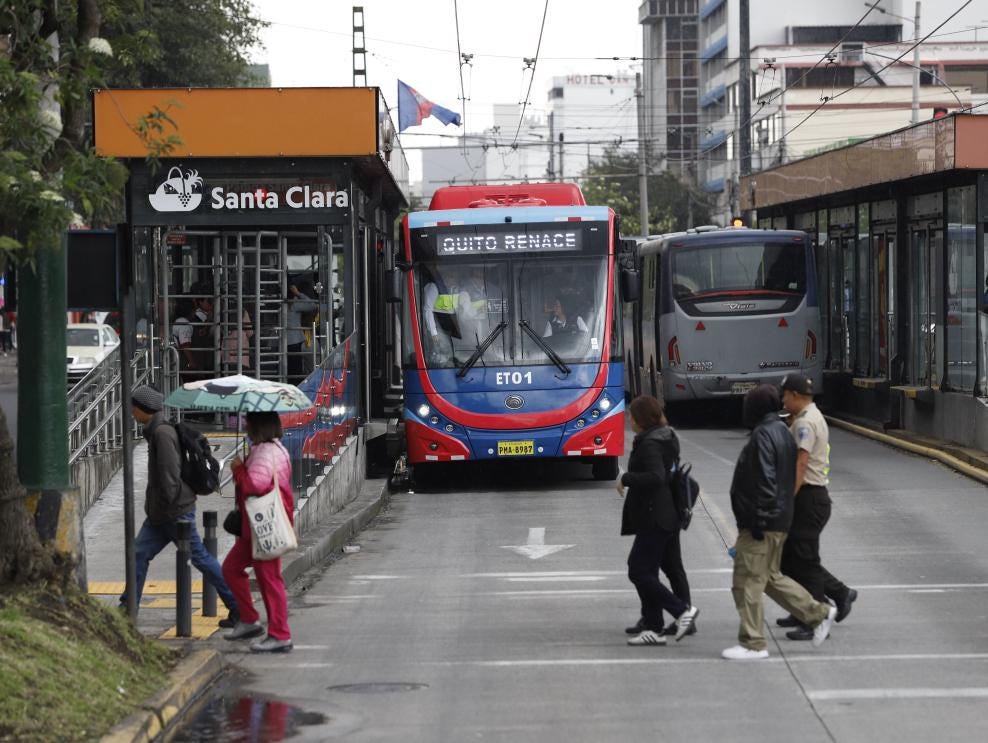
According to news reports published this past December, the Comptroller General’s Office of Ecuador confirmed that there are signs of alleged criminal liability in the Municipality of Quito’s procurement of 60 electric trolleybuses from the Chinese company Yutong. The project was carried out with support from the United Nations Office for Project Services (UNOPS) (La Hora). Although UNOPS presents itself as the UN agency specializing in public procurement and infrastructure, its effectiveness and transparency are increasingly being called into question.
The report’s findings will be forwarded to the Attorney General’s Office for further investigation. In addition, the technical audit identifies potential administrative liabilities of USD 79,000 and civil liabilities of USD 2.5 million (La Hora).
The USD 35.3 million operation began with a memorandum of understanding between Mayor Pabel Muñoz and UNOPS. Subsequently, and without an open bidding process or prior technical assessment, the general manager of the Quito Public Passenger Transport Company (EPMTPQ) directly invited UNOPS to submit a proposal to oversee the procurement (Expreso).
The Comptroller’s Office stated that, because the trolleybuses are considered standardized goods, they should have been acquired through a reverse electronic auction, as required by Ecuador’s Organic Law of the National Public Procurement System. However, the municipality instead used an exceptional procurement method without documented justification (La Hora).
The report also noted that technical meetings between UNOPS and EPMTPQ lacked documentation detailing how implementation costs, indirect expenses, and financial terms were calculated (La Hora).
Another critical finding revealed that the delivered vehicles failed to meet 15 of the 80 technical specifications outlined in the contract—potentially constituting a breach and resulting in financial harm to the state (Expreso).
In April 2024, the National Public Procurement Service (Sercop) had already identified irregularities in the process, prompting public complaints from city council members who described the operation as a “triangulation” designed to bypass control and transparency mechanisms (Expreso). Throughout the process, Councilman Wilson Merino denounced the purchase as having been conducted through an opaque scheme involving a procurement agent banned by law. He cited technical failures, a lack of transparency, and cost overruns that harmed the city. After ten months of oversight, he reported receiving threats and pressure, and he criticized the memorandum signed between the mayor and UNOPS, which—according to him—enabled the irregular contracting.
This case once again casts doubt on UNOPS’s role in public procurement. While it presents itself as a guarantor of efficiency and transparency, its direct involvement—operating outside national procurement systems—not only enables it to evade formal oversight but also leads to unfair competition with legally established public procurement mechanisms. The absence of clear documentation, opaque cost structures, tolerance of noncompliant deliveries, and failure to act as a neutral watchdog against corruption seriously undermine its credibility as a reliable intermediary in large-scale public acquisitions.
Sources:
La Hora
“Comptroller’s Office finds procurement violations and establishes liability in the Municipality of Quito”
https://www.lahora.com.ec/quito/contraloria-detecta-incumplimientos-en-la-contratacion-de-trolebuses-electricos-y-establece-responsabilidades-en-el-municipio-de-quito-20251210-0020.html
Expreso
“Trolleybus purchase: ‘From the beginning we saw triangulation,’ says councilman”
https://www.expreso.ec/quito/compra-de-trolebuses-desde-un-inicio-detectamos-una-triangulacion-dice-concejal-267457.html
Primicias
“Municipality responds to Comptroller’s Office: No mayoral liability in electric trolleybus purchase”
https://www.primicias.ec/quito/municipio-respuesta-contraloria-responsabilidad-alcalde-compra-trole-buses-electricos-111529
Swissinfo (via EFE)
“Ecuador’s Comptroller’s Office warns of possible criminal offenses in Quito trolleybus deal”
https://www.swissinfo.ch/spa/contralor%C3%ADa-de-ecuador-advierte-indicios-de-delito-penal-en-compra-de-trolebuses-de-quito/90618902
Image by: Gustavo GUAMAN | expreso.ec
Editorial Note: This platform shares content of public interest that has been circulated through media or official channels. We ensure that all original sources and authors are duly acknowledged and respected. Our intent is to amplify transparency and access to information without infringing on any copyrights.
The gap between advertised transparency and actual oversight is huge here. When an intl organization markets itself as a procurement solution but then helps skirt local procurement laws, that defeats the whole purpose. The 'no open bidding process' combined with UNOPS invoking immunity creates exactly the kind of accountability vacuum that breeds corruption. Similar patterns pop up whenever you layer international bodies on top of local governance without clear boundries.
UNOPS’ role should be to strengthen national capacities, not to circumvent government controls. Upper-middle-income countries already possess sufficient institutional and technical capacity to rely on their own systems. In such contexts, UNOPS should support the effective use and improvement of national systems, rather than facilitating parallel arrangements that bypass them.
The serious cases observed in Peru illustrate precisely what must not be done: the use of institutional arrangements, and, worse, the invocation of privileges and immunities, to evade oversight and accountability. This approach is inconsistent with UNOPS’ mandate, undermines domestic governance, and exposes the organization to significant integrity and reputational risks.